You’ve tried weekly therapy. You’ve met with the school counselor more times than you can count. Maybe your son has already had a short hospital stay, and within weeks things were back where they started. Now you’re looking at programs for troubled youth in NC and wondering whether any of them are within reach for your family.
If your teen has North Carolina Medicaid, there is real reason for hope. Residential treatment is a covered benefit for young people under 21, and the rules that govern it are more generous than many parents expect.
Yes. North Carolina Medicaid covers residential treatment for teens under age 21 when a licensed clinician determines it is medically necessary. Coverage includes several levels of 24-hour residential care, from therapeutic group homes to psychiatric residential treatment facilities (PRTFs). Every level requires prior approval, and a federal protection called EPSDT can extend coverage beyond standard policy limits when a teen’s needs call for it.
Key Takeaways
- NC Medicaid covers residential treatment for youth under 21 when it is medically necessary.
- North Carolina has four levels of residential treatment plus PRTFs. Each has a different amount of structure and supervision.
- Every level requires prior approval, and the service must be ordered by a physician, psychiatrist, or licensed psychologist.
- EPSDT is a federal rule that can override standard coverage limits for teens when care is medically necessary.
- The right program depends on your teen’s clinical needs, and a program that works with your specific Medicaid plan makes approval much smoother.
What Is Teen Residential Treatment?
Teen residential treatment is a 24-hour, live-in program where adolescents receive mental and behavioral health care in a structured, supervised setting. Unlike weekly outpatient therapy, residential care surrounds a teen with support all day, including therapy, daily routines, school, and skill-building.
It is not the same as a hospital stay. Psychiatric hospitals focus on short-term crisis stabilization. Residential programs are built for the longer work that comes after: learning to manage emotions, repairing family relationships, and practicing new skills until they hold.
For many families, residential care is the step between “outpatient isn’t enough” and “we can’t keep doing this.”
What Does NC Medicaid Cover for Teens?
North Carolina Medicaid covers residential treatment for enrolled youth under age 21. The state’s Clinical Coverage Policy 8D-2 for Residential Treatment Services describes these services as providing a structured, therapeutic, and supervised environment to improve a young person’s level of functioning.
The most important protection for families is EPSDT (Early and Periodic Screening, Diagnostic, and Treatment). EPSDT is a federal Medicaid requirement that the state cover services for members under 21 when they are medically necessary to correct or improve a physical or mental health condition. Under EPSDT, limits on how long, how often, or where a service is provided can be exceeded when documentation shows the care is medically necessary.
EPSDT does not skip the paperwork. As NC Medicaid’s Clinical Coverage Policy 8D-1 for Psychiatric Residential Treatment Facilities makes clear, prior approval is still required for residential care, even for members under 21. For a broader look at therapy, psychiatry, and crisis services, see our guide to Medicaid coverage for teen mental health in North Carolina.
Programs for Troubled Youth in NC: The Levels of Care Medicaid Covers
When parents search for group homes for troubled youth or residential programs, they often find a confusing mix of names. North Carolina organizes Medicaid-funded residential care into clearly defined levels.
| Level of Care | Setting | Structure and Supervision | Generally a Fit For |
| Level I (Family Type) | Licensed family home | Low to moderate structure | Teens whose progress is fragile and who need extra support in a family setting |
| Level II (Family Type) | Therapeutic foster home, 1–2 youth | Moderate to high structure | Teens who need intensive support in a family setting |
| Level II (Program Type) | Licensed residential program or group home | Moderate to high structure; at least 1 staff member per 4 youth at all times | Teens with serious struggles at home and school who don’t need a locked or hospital setting |
| Level III | Staff-secure program | High structure; staff awake overnight; at least 4 hours of professional services per week | Teens with frequent aggression or high-risk behavior |
| Level IV | Physically secure, locked program | Highest residential structure; at least 8 hours of professional services per week | Teens whose safety needs require a locked setting |
| PRTF | Non-acute inpatient facility directed by a psychiatrist | 24-hour supervision with specialized clinical care | Teens not stable enough for a lower level, often with a history of repeated hospitalizations |
Sources: NC Medicaid Clinical Coverage Policy 8D-2 and Clinical Coverage Policy 8D-1.
Level II Program Type is what most families picture when they think of a therapeutic group home. NC policy describes it as intensive, interactive therapeutic care that stops short of a staff-secure or locked setting. It is built for teens who need 24-hour structure but not hospital-level care.
Is It Time to Consider Residential Care? A Quick Self-Check
This checklist can’t diagnose your teen or decide their level of care. That is a licensed clinician’s job. It can help you put words to what you’re seeing before you talk to a provider.
Answer yes or no:
- Has weekly outpatient therapy gone on for months without lasting change?
- Is school falling apart, with failing grades, refusal to attend, or constant calls from the school?
- Are conflicts at home frequent or intense enough that the household feels on edge?
- Has your teen had a hospital stay or crisis visit, then slipped back within weeks?
- Does your teen struggle to accept direction from any adult, not just you?
- Has medication helped some symptoms but not enough?
- Do you feel you can no longer keep your teen, or others at home, safe on your own?
Several “yes” answers don’t automatically mean residential care is right. They are a strong sign it’s time to ask a clinician whether a higher level of care should be considered. North Carolina’s Level II criteria include moderate to severe difficulty at home, frequent disruptive behavior, and serious functional problems at school.
How NC Medicaid Approval for Residential Treatment Works
Approval follows a predictable path, even though it can feel overwhelming from the outside:
- Clinical assessment. A licensed clinician evaluates your teen and documents their diagnosis and needs.
- Service order. Residential treatment must be ordered by a primary care physician, psychiatrist, or licensed psychologist, on or before the day services begin.
- Prior approval request. The provider submits the request and supporting records for review. Every residential level, Level I through IV, requires prior approval.
- Ongoing review. Once your teen is enrolled, reviewers check progress to confirm continued care is still needed.
- Your right to appeal. If a service is denied, reduced, or ended, you must be told about your appeal rights.
A good residential program handles most of this with you. You should not have to become a Medicaid expert to get your child help.
Which NC Medicaid Plan Is Your Teen On?
Most North Carolina teens receive Medicaid through a managed care health plan. Your plan affects which providers are in network and who reviews authorization requests.
- Standard Plans cover most children and teens.
- Tailored Plans serve members with more significant behavioral health needs.
- The Children and Families Specialty Plan, run by Healthy Blue Care Together, launched December 1, 2025, according to NCDHHS. It serves Medicaid-enrolled children and youth currently or formerly involved with the child welfare system, including teens in foster care or receiving adoption assistance.
If you aren’t sure which plan your teen has, check the Medicaid card or call the number on the back. A program’s admissions team can also help you find out.
Why Finding the Right Program in North Carolina Is So Hard
If you’ve struggled to find help, it isn’t just you. North Carolina is facing a serious shortage of mental health providers, especially in rural areas. In January 2026, WECT reported that some rural parts of the state have only one mental health provider for every 5,000 residents. The same report noted that many providers don’t accept Medicaid, which pushes families toward long waits or no care at all.
Mental Health America’s 2025 State of Mental Health in America report ranked North Carolina 18th of 51 for youth mental health, a measure that includes both how common mental illness is among youth and how easy it is to get care.
For families on Medicaid, the challenge is finding a program that accepts Medicaid and offers long-term, high-quality clinical care. That combination is rare.
Residential Treatment in Western North Carolina That Accepts Medicaid
BlueRock Behavioral Health is a North Carolina Medicaid Level II certified residential treatment program for adolescent boys ages 14 to 17. Our campus sits on 140 acres in the Blue Ridge foothills near Hendersonville, about 40 minutes from Asheville. We serve families from across Western North Carolina and throughout the state.
We built BlueRock on a simple belief: all families deserve the same caliber of care, regardless of their financial situation. Your son shouldn’t get less time, less therapy, or a worse setting because of how you pay for treatment.
How we work with NC Medicaid:
- We are an in-network provider with Vaya Partners and Healthy Blue Care Together.
- For other Medicaid health plans, we work with you to request a Single Case Agreement to authorize treatment for your son at BlueRock.
- Our team helps prepare authorization paperwork, coordinates with your plan’s care manager and existing clinical/treatment team, and answers your questions along the way.
- Families on commercial insurance are welcome too, and we help you pursue coverage with your insurer.
Wondering whether your son’s Medicaid plan will cover BlueRock? Call our admissions team at (828) 845-8454. We’ll help you understand your options, with no pressure and no obligation.
What Your Son’s Days Look Like at BlueRock
Most students stay with us for 90 to 180 days. That is long enough for real change to take root, not just short-term stabilization. Every length of stay is individualized and tied to your son’s clinical and academic goals.
Clinical care built on relationships. Our licensed clinicians provide trauma-informed, attachment-based therapy on site. We blend CBT- and DBT-informed skills work with motivational interviewing and experiential activities. Many of our students are dealing with anxiety, depression, trauma, ADHD, or school refusal. When substance use is part of the picture, it’s usually a sign of deeper struggles, and we treat the whole person.
School doesn’t stop. While enrolled at BlueRock, your son attends Bearwallow Academy, our on-site school with in-person, NC-licensed teachers. Classes typically have no more than eight students. We coordinate credit transfer with your home district and support IEPs and 504 plans, so he doesn’t fall behind while he heals.
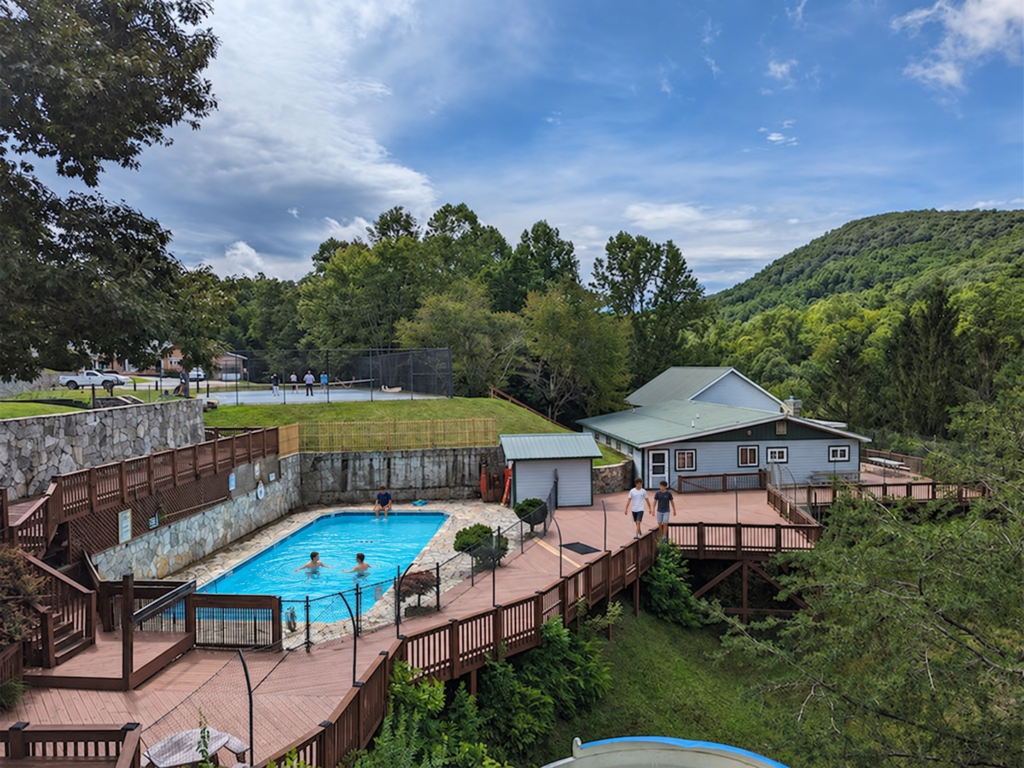
A campus designed with intention. Dorms, classrooms, clinical spaces, dining, and recreation each have their own building. The Blue Ridge setting gets students off screens and outdoors, moving their bodies and building confidence through experiential programming. It is a therapeutic community where structure creates safety, not a lockdown facility. You can see more on our Life at BlueRock page.
Your family stays at the center. Families take part in weekly family therapy and parent coaching and get regular updates from the treatment team. We plan for your son’s return home from the first day, including aftercare that keeps his progress going.
If you’d like to see the campus in person, read what families should look for when touring a teen residential treatment program. Then ask us about scheduling a visit.
For Care Managers, Clinicians, and School Professionals
If you’re a care manager, therapist, psychiatrist, or school social worker supporting a young person who may need Level II residential care, we’d welcome the chance to work with you. Submit an agency and provider referral and our team will follow up to review fit and next steps.
Frequently Asked Questions
Does NC Medicaid pay for residential treatment for teens?
Yes, NC Medicaid covers residential treatment for members under 21 when it is medically necessary and approved in advance. Coverage includes Levels I through IV residential treatment and psychiatric residential treatment facilities. Your teen’s clinician and the residential program handle the authorization request.
What is the difference between a group home and a PRTF?
A Level II Program Type group home offers 24-hour structured care in a community-based setting, while a PRTF provides more intensive, psychiatrist-directed care for youth who are not stable enough outside a highly structured therapeutic environment. According to NC Medicaid’s PRTF policy, PRTFs are often for teens with a history of repeated hospitalizations.
How long does Medicaid cover residential treatment?
There is no single fixed limit; Medicaid covers residential treatment as long as it remains medically necessary. Reviewers check progress during the stay to confirm continued need. At BlueRock, most students stay between 90 and 180 days.
Can my teen come home for visits during treatment?
Yes, Medicaid allows therapeutic leave for home visits that the treatment team agrees support your teen’s goals. Under NC Medicaid’s residential treatment policy, Level II through Level IV programs allow up to 45 days per calendar year, with no more than 15 days in any three-month quarter.
Will my son fall behind in school?
Not at BlueRock. Students attend Bearwallow Academy, our on-site school, with small classes led by NC-licensed teachers. We coordinate credit transfer with your home district and support IEP and 504 accommodations. Learn more about academics at BlueRock.
What if Medicaid denies coverage?
You have the right to appeal any denial, reduction, or ending of services, and you must be notified of those rights. Because EPSDT requires coverage of medically necessary care for members under 21, strong clinical documentation often makes the difference.
Do we need a referral to start?
Families can reach out to BlueRock directly. Our admissions team will explain what records we need and help coordinate the clinical documentation required for Medicaid approval. Professionals can use our agency and provider referral form.
Your Son Is Not Beyond Help
If you’re reading this, you’ve probably been carrying more than any parent should have to carry alone. The cycle of therapy that doesn’t hold and short stays that don’t stick can be broken with enough time, structure, and the right clinical care. Medicaid shouldn’t stand between your son and that chance.
Call BlueRock at (828) 845-8454 to talk with our admissions team about your son, your Medicaid plan, and whether BlueRock is the right fit.
If you or someone you love is in crisis, help is available 24/7:
- SAMHSA National Helpline: 1-800-662-HELP (4357)
- 988 Suicide & Crisis Lifeline: Call or text 988
- Crisis Text Line: Text HOME to 741741