
Once you’ve sent your teen to a residential treatment center, there’s a new challenge: supporting the other siblings when your teen is in residential treatment. Chances are, you’ve put most of your focus on the child in crisis. But the family dynamic has been altered across the board. Now you need to address the needs, worries, and more for the children still at home.
Supporting siblings when a teen is in treatment requires a delicate balance. You need to validate feelings, offer honest communication, and push for connection. Everyone is feeling the weight of this major shift. Recognizing that every member of the family is going through their own version of this transition is the first step toward healing.
Why Siblings Feel What They Feel
It is normal for siblings to experience a complex swirl of emotions when a brother or sister leaves for treatment. Their world has likely been revolving around the teen in crisis for months or even years. When that sibling suddenly departs for a sanctuary in the Blue Ridge foothills, the silence at home can be just as disorienting as the previous chaos.
The Attention Shift They Are Experiencing
For a long time, the teen in treatment likely required the “lion’s share” of parental attention. Siblings often become “the good kids” or “the quiet ones” to avoid adding more stress to an already strained household. They may have felt invisible or secondary to the crisis.
Now that the teen is away, the attention shift continues. Parents are often preoccupied with clinical updates, insurance calls, and the emotional toll of the separation. Siblings may feel that even in absence, the teen in treatment still occupies the center of the family’s emotional life. Validating that their need for your time is just as important as the teen’s need for treatment is essential.
Relief, Guilt, and Resentment All at Once
Many children feel a secret sense of relief when the house finally becomes calm. However, that relief is often followed by intense guilt. They may feel like “bad” brothers or sisters for enjoying the peace. At the same time, resentment can build because they are the ones dealing with the fallout at home while their sibling is away in what they might perceive as a “special” or “expensive” school.
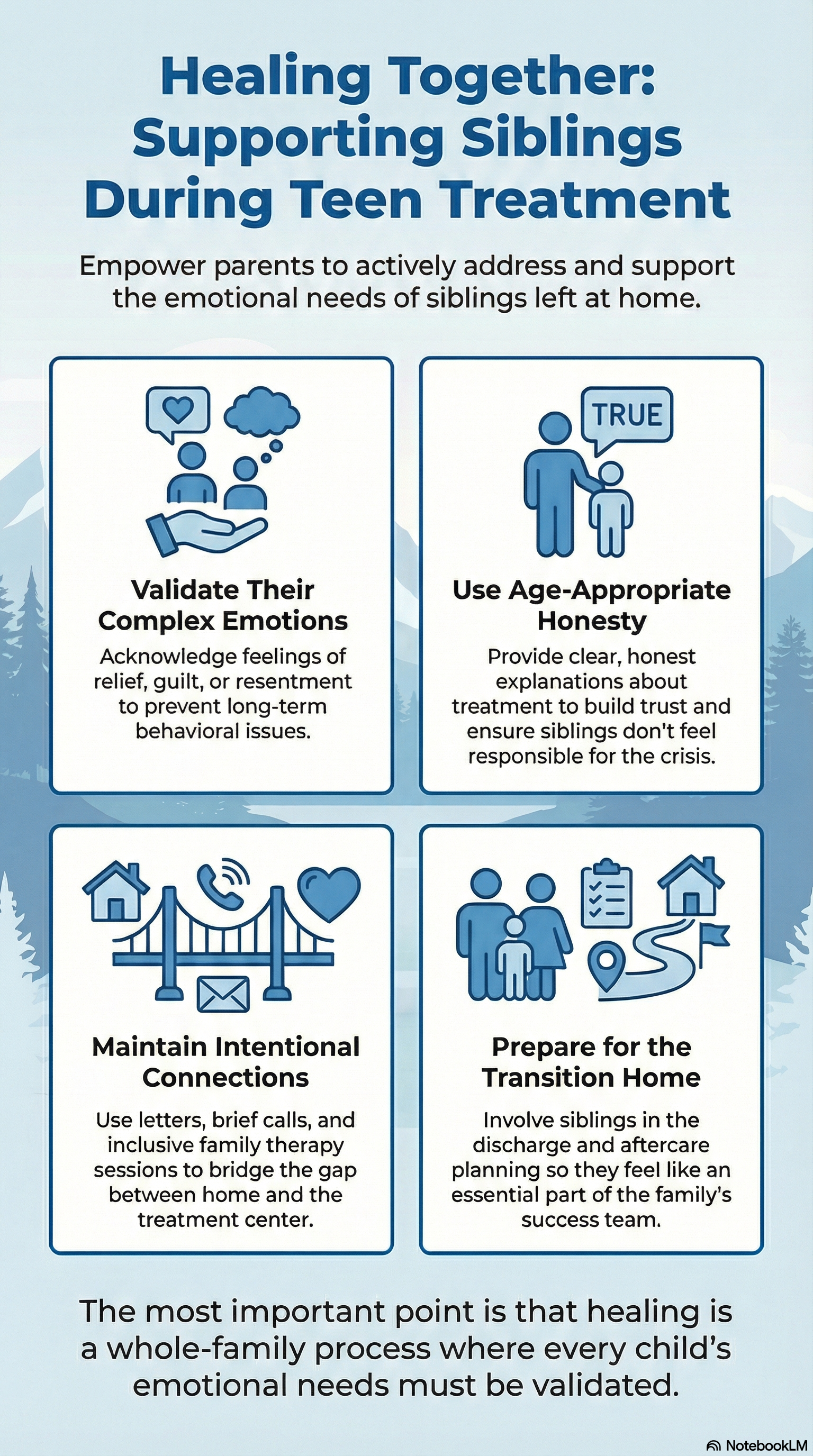
This emotional tug-of-war is a standard part of family dynamics during adolescent treatment. Allowing siblings to express these conflicting feelings without judgment helps prevent these emotions from turning into long-term behavioral issues.
The Questions Siblings Ask And How To Answer Honestly
Honesty builds trust. When siblings ask hard questions, they are looking for a sense of stability in an unstable time.
“Why Does My Sibling Get To Leave And I Have To Stay?”
This question often stems from a mix of resentment and misunderstanding. Acknowledge that it feels unfair that the teen gets a change of scenery. Explain that treatment is hard work. It isn’t a vacation; it is an intensive process of learning new skills and facing difficult truths. Remind them that they get to stay home because they are currently healthy and capable of managing their life here, while their sibling needs more help.
“Is It My Fault?”
Even if they don’t ask it out loud, many siblings carry the weight of “what if.” They might remember a fight they had or a time they were mean. Reassure them clearly and frequently: “You did not cause this. This is about [Sibling]’s health, and it is something the adults and doctors are handling.”
“When Are They Coming Home?”
Avoid giving a specific date if you don’t have one. Instead, talk about the “progression” of treatment. You can say, “They will come home when the doctors and our family feel they have the tools to stay healthy here. We are taking it one step at a time to make sure they are ready.”
If you are navigating these conversations and wondering how family therapy can help everyone heal, our team can walk you through how BlueRock includes siblings in the process—even from a distance. Healing happens in relationship to the whole family, not just the teen in treatment.
Keeping Connection Alive During Treatment
Supporting siblings North Carolina families often means bridging the gap between home and the treatment center through intentional communication.
Letters, Calls, and Family Therapy Sessions
Letters are a powerful, low-pressure way for siblings to connect. It allows them to share small updates about their life without the emotional intensity of a phone call. When phone calls are allowed, keep them brief and positive initially.
BlueRock emphasizes family therapy during teen treatment as a cornerstone of the program. This often includes virtual or in-person sessions where siblings can participate. These sessions provide a safe, moderated space for siblings to share their feelings and for the teen in treatment to offer amends or updates.
What Siblings Can And Cannot Expect From Communication
Manage expectations early. Siblings need to know that their brother or sister might not sound like themselves at first. They may be angry, sad, or very quiet. Explain that the teen is doing a lot of emotional work and may not always have the energy for long chats. Setting these boundaries protects the sibling from feeling rejected if a call doesn’t go well.
When The Household Finally Feels Calmer
As the weeks pass, the atmosphere in your North Carolina home will likely shift. The “crisis mode” begins to fade, replaced by a new, quieter routine.
Permission To Acknowledge The Relief
It is okay to enjoy the peace. Parents often feel they must remain in a state of perpetual mourning because one child is away, but this can inadvertently signal to the other children that their happiness is inappropriate. Give yourself and your children permission to have fun, go to the movies, and enjoy the calmer dynamic. This “geographic pause” is a time for everyone to recharge.
Preparing Siblings For Your Teen’s Return
Reintegration is a major step in the continuum of care. Siblings need to know that things won’t immediately go back to “normal.” The teen coming home will be using new skills, and the family will need to support those changes. Discussing the discharge plan and aftercare steps with the siblings makes them feel like part of the success team rather than just bystanders to the teen’s return.
Family Therapy Why Siblings Are Part Of Healing At BlueRock
At BlueRock, we believe that the teen is not the only person who needs support. Residential treatment is a family intervention. If only one person changes, the old family system will eventually pull them back into old patterns.
Including siblings in family sessions allows them to feel seen and heard. It gives them a platform to voice their resentment or their hopes for the future. By treating the family as a unit, we ensure that the progress made in the Blue Ridge mountains translates to a healthier, more stable home in Charlotte, Raleigh, or wherever you call home in North Carolina.
Why Choose BlueRock Behavioral Health
BlueRock provides a clinically-sophisticated residential sanctuary for teens, but our mission extends to the whole family. We recognize that supporting siblings when a teen is in treatment is a vital component of long-term success. Our differentiators include:
- Comprehensive Family Programming: We offer dedicated sessions and resources specifically designed for siblings.
- Evidence-Based Care: Our use of CBT and DBT helps teens develop the emotional regulation skills they need to return home successfully.
- The Mountain Sanctuary Advantage: Our location provides a peaceful setting for families to reconnect during visiting days and family intensives.
- Continuous Support: We assist with the “step down” process, ensuring the continuum of care remains strong through outpatient and aftercare planning.
How To Start The Family Healing Process
If your family is struggling with the impact of an adolescent’s behavioral health crisis, help is available. Our admissions team can help you understand our programs, verify your insurance, and explain how we support every member of your household.
We invite you to reach out for a family programming consultation. Healing is a relationship-based process, and we are here to support your entire family through this journey. Call us today at (828) 845-8454 to learn more about our North Carolina residential treatment options.
Crisis And Emergency Guidance
If a family member is in immediate danger or experiencing a life-threatening emergency, please call 911 immediately. For those in a mental health crisis, the 988 Suicide & Crisis Lifeline provides 24/7, free, and confidential support. You can reach them by calling or texting 988 or visiting 988lifeline.org.
In North Carolina, you can also access the North Carolina Department of Health and Human Services (NCDHHS) crisis resources for additional local support and treatment locators.
Learn More
- Substance Abuse and Mental Health Services Administration (SAMHSA) – Supporting Families
- National Alliance on Mental Illness (NAMI) – Sibling Support
- Child Mind Institute – Supporting Siblings of Kids With Mental Health Disorders
- North Carolina 211 – Family Support Resources