If your teenager hasn’t been to school in days, or longer, and every morning is a standoff that ends in tears, a shutdown, or a physical complaint that makes no sense medically, you’re probably past wondering whether this is normal. You’re wondering what’s wrong, and whether you’ve missed something important.
You haven’t missed it. What you’re likely seeing has a name.
School refusal isn’t just truancy; it is a pattern in which a teen experiences significant emotional distress around school attendance, and that distress becomes the obstacle, not defiance. It’s not about skipping. It’s not about laziness. BlueRock Behavioral Health can help you understand that difference is where everything else begins.
Key Takeaways
- School refusal is emotionally driven. Truancy is behaviorally driven. They look similar but require completely different responses.
- Physical symptoms (stomachaches, headaches, nausea) on school mornings are common and real, even without a medical cause.
- Anxiety, depression, trauma, and attachment disruption are the most frequent drivers.
- When school refusal persists for weeks, outpatient support alone often isn’t enough.
- Residential treatment does not mean falling behind academically. The right program keeps your teen enrolled and learning.
What Is School Refusal, and Why It’s Not the Same as Skipping
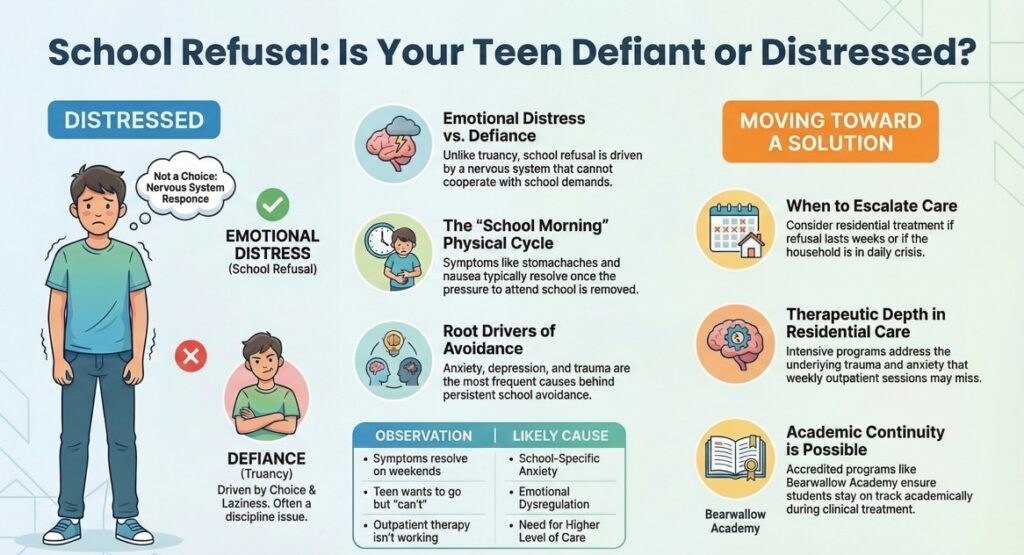
School refusal in teens is the persistent difficulty attending or staying in school due to emotional distress, most often tied to anxiety, depression, trauma, or social fear. Unlike truancy, which involves a teen making a choice to avoid school without significant distress, a teen with school refusal typically wants to comply but can’t. Their nervous system won’t cooperate. The refusal is a symptom, not a decision.
This distinction matters because the interventions are completely different. Pressure and consequences can sometimes redirect truancy. Applied to school refusal, they almost always make things worse.
Because school refusal is driven by underlying anxiety, depression, or trauma, effective treatment focuses on identifying and addressing those root causes. Treatment for school refusal may include structured therapy, psychiatric evaluation, family involvement, and in more severe cases, residential treatment designed specifically for adolescents struggling with emotional dysregulation and school avoidance.
Signs You’re Seeing School Refusal, Not Defiance
Physical Symptoms That Show Up on School Mornings
One of the most disorienting parts of school refusal is how physical it gets. Parents often spend months in pediatricians’ offices before anyone mentions behavioral health.
Common physical symptoms include stomachaches that resolve by mid-morning, headaches, nausea, vomiting, fatigue that lifts once school hours pass, and dizziness. These are not fabricated. They are the body expressing what the mind can’t regulate. When a teen’s nervous system is in a state of threat, physical symptoms are an expected output.
Quick self-check: Does your teen show any of these patterns?
- Symptoms appear almost exclusively on school mornings (weekends and holidays are different)
- Complaints resolve once it’s clear they won’t be going to school
- Symptoms have been medically evaluated but no physical cause was found
- Your teen seems genuinely scared, not calculating
- Mornings have become a daily crisis that leaves everyone exhausted
- Your teen expresses wanting to go to school but feeling unable to
- Attendance has dropped significantly over the past month or more
If you checked two or more, what you’re seeing is unlikely to be defiance.
Emotional and Behavioral Patterns to Watch For
Beyond the physical signs, school refusal tends to show up as escalating anxiety on Sunday evenings, meltdowns that seem disproportionate to the situation, social withdrawal, and an increasing inability to tolerate transitions. Some teens become completely rigid around routine. Others swing between clingy and explosive.
Parents often describe a version of their child they don’t recognize. That’s accurate. Chronic emotional dysregulation changes how adolescents present. It’s not a personality shift. It’s a nervous system under prolonged strain.
What’s Actually Driving School Refusal in Teens
Anxiety and Social Fear
Anxiety is the most common driver of school refusal. Social anxiety, generalized anxiety, separation anxiety, and panic disorder all generate the same output: school becomes associated with an anticipated threat, and avoidance provides temporary relief. That relief reinforces the avoidance, and the cycle tightens.
For some teens, the fear is specific (a class, a hallway, lunch period). For others, it’s diffuse. Everything about school feels unsafe, and they can’t explain why.
Depression and Emotional Dysregulation
Depression in adolescents often looks less like sadness and more like irritability, hopelessness, and an inability to initiate. Getting out of bed is genuinely hard. Getting dressed, getting in the car, walking into a building full of people. It compounds fast.
When depression and anxiety co-occur, and they frequently do, school refusal becomes especially entrenched. Neither condition is responding to the other. Both need direct treatment.
Trauma Responses and Attachment Disruption
Some school refusal is rooted in experiences that happened long before high school: early relational trauma, instability at home, a history of feeling unsafe in environments meant to be safe. The school building becomes a context in which that earlier threat gets re-activated.
Attachment disruption is a particularly important piece for adolescents. When a teen’s core relationship to safety and caregiving has been disrupted, separation from home can feel threatening even when home is objectively stable now. Outpatient therapy can begin to address this, but for teens with complex trauma histories, an hour a week is rarely sufficient to interrupt the pattern.
This is where families sometimes reach a wall: they’ve done the outpatient work, the school counselor is involved, and things are still getting worse. That’s not a failure of effort. It’s a signal that the level of support needs to change.
Is what you’re seeing more than school refusal can hold?
We put together a short checklist to help you name what you’re seeing. Download it, sit with it, and reach out if and when you’re ready.
When School Refusal Requires Professional Treatment: Knowing When to Escalate
Parents ask this question in a particular way: “Have we waited too long?” The answer, almost always, is no. But the urgency is real.
When school refusal has lasted more than a few weeks, when your teen is losing connections and academic ground, when your household is in daily crisis and nothing you’ve tried has held, the question isn’t whether to get more support. It’s what kind.
Structured residential care is a legitimate option for teens whose school refusal is severe, persistent, or tied to complex underlying conditions. This isn’t a last resort reserved for teens who’ve run out of options. It’s a clinical level of care for teens who need more time, more consistency, and more therapeutic depth than outpatient settings can provide.
If you’re not sure whether what you’re seeing rises to that level, you don’t have to figure it out alone. We’re glad to talk it through.
School Refusal Treatment in Western North Carolina
Families in Western NC and the surrounding region face a gap that doesn’t get talked about enough: there are outpatient resources, and there are acute crisis settings, but very little in between that offers both clinical depth and enough time for real change to happen.
Short-term interventions can stabilize a teen in crisis. They rarely resolve the underlying conditions driving school refusal, especially when anxiety, depression, and trauma are all part of the picture.
BlueRock Behavioral Health, located in Hendersonville, NC, in the Blue Ridge foothills, offers residential treatment specifically designed for adolescents with complex behavioral and mental health needs. The 140-acre campus provides the space and structure for therapeutic work that isn’t possible in a weekly outpatient session.
One of the most common fears parents bring to us: “If my child goes to residential treatment, will they fall behind in school?” It’s the right question. Bearwallow Academy, BlueRock’s on-site accredited school, means students stay enrolled and on track academically throughout treatment. Falling behind isn’t a given. With the right program, it doesn’t have to happen at all.
If your teen has been refusing school for weeks, if you’ve tried outpatient support and it hasn’t held, if you’re exhausted and scared and looking for something that can actually meet the complexity of what you’re facing, contact BlueRock. Call us or fill out the contact form to start a conversation. You don’t have to have all the answers before you reach out.
Frequently Asked Questions
What is the difference between school refusal and truancy?
Truancy involves a teen choosing not to attend school, typically without significant emotional distress. School refusal involves a teen who experiences genuine emotional or physiological distress around school attendance. They often want to go but can’t. The motivation is the key difference, and it changes what kind of response will actually help.
Is school refusal a mental health condition?
School refusal is not a standalone mental health diagnosis, but it is a behavioral pattern that almost always reflects an underlying mental health condition such as anxiety, depression, or trauma. Effective treatment for school refusal requires identifying and treating those root causes rather than focusing only on school attendance.
What causes a teenager to suddenly refuse to go to school?
Sometimes there’s a clear trigger (a social conflict, a traumatic event, a change in environment). Often the onset looks sudden but reflects a slow build: cumulative stress, unaddressed anxiety, or depressive symptoms that finally cross a threshold. A clinical evaluation can help identify what’s underneath.
What is the best treatment for school refusal in teens?
The best treatment for school refusal depends on severity. Mild cases may respond to outpatient therapy focused on anxiety and gradual re-entry plans. Moderate to severe cases — especially those lasting several weeks or involving depression or trauma — often require a higher level of care such as structured residential treatment, where teens receive daily therapeutic support while remaining academically engaged.
How long does school refusal last if left untreated?
It tends to worsen without intervention. The longer a teen avoids school, the more entrenched the avoidance becomes, the more they fall behind academically and socially, and the harder re-entry becomes. Early and appropriate intervention changes this trajectory significantly.
When should I consider residential treatment for school refusal?
When school refusal has persisted for several weeks, when outpatient therapy hasn’t produced meaningful change, when your teen’s functioning is deteriorating across multiple areas, or when there are co-occurring conditions (anxiety, depression, trauma) that require more intensive support than weekly sessions can provide.
Will my child fall behind academically if they need residential care?
Not at BlueRock. Bearwallow Academy is an accredited on-site school where students remain enrolled in coursework throughout residential treatment. Academic continuity is built into the program.
When does school refusal require professional help instead of at-home strategies?
If home strategies (routine adjustments, gradual re-entry plans, communication with the school) haven’t produced improvement after a few weeks, or if your teen’s distress is escalating rather than stabilizing, it’s time to bring in clinical support. A therapist who specializes in adolescents and anxiety is a good starting point; residential care becomes relevant when that level of support isn’t enough.
Are there residential programs in North Carolina that address school refusal?
Yes. BlueRock Behavioral Health in Hendersonville, NC accepts Medicaid and commercial insurance and provides residential treatment for adolescents with complex behavioral and mental health needs, including school refusal. Bearwallow Academy ensures students stay on track academically during their enrollment.
Start Your Admissions Today
Call 828-845-8454 to speak with our team that can answer your questions, verify your insurance and talk to you through enrolling your child at BlueRock.
Safety Resources
If you or someone you know is in crisis, please reach out.