Dealing with a teen facing explosive emotions can take a toll on parents as teen crises seem to come out of nowhere.
You may have heard a therapist or two mention DBT. But did you really listen?
DBT, Dialectical Behavior Therapy, at BlueRock Behavioral Health, is a skilled-based treatment for people who experience more intense emotions than most.
The strategy teaches concrete techniques, not just insights, for surviving difficult moments in life, understanding feelings and building relationships that usually blow up. It is especially helpful in youth mental health treatment.
What Is DBT and Why It Works for Teens
DBT was developed in the late 1980s by psychologist Marsha Linehan, originally for adults with chronic suicidality and borderline personality disorder. Over time, researchers adapted it for adolescents and found it particularly effective because teens are already in a developmental window where emotional intensity is biologically heightened. The brain’s emotional centers are running hot while the prefrontal cortex, which handles impulse control and long-range thinking, won’t finish developing until the mid-twenties.
The “dialectical” isn’t just jargon, but it describes something real: holding two seemingly opposite things as both true at the same time. Your teen is doing the best they can and needs to do better. The situation is genuinely painful and change is possible. This both/and framing matters because a lot of struggling teens get stuck in black-and-white thinking that makes every hard moment feel permanent and every relationship feel all-or-nothing.
The Four Core Skills of DBT
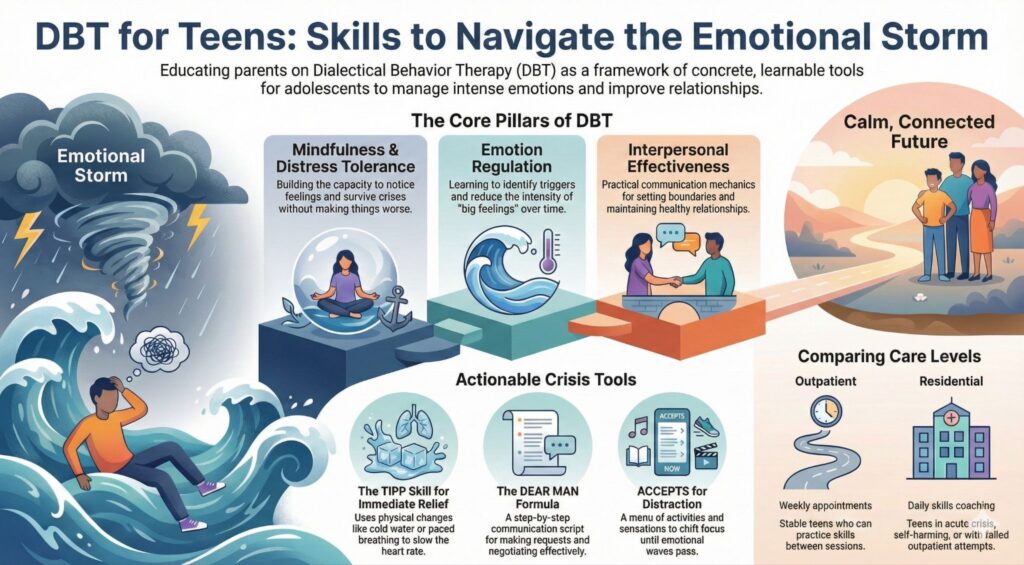
DBT organizes its skills into four modules, each targeting a different layer of how teens struggle:
- Mindfulness is the foundation everything else builds on. It’s the practice of noticing what’s happening internally without immediately reacting to it.
- Distress tolerance gives teens tools for getting through a crisis without making things worse, because sometimes the goal is just to survive the moment intact.
- Emotion regulation goes deeper: learning to identify feelings, understand what triggers them, and eventually reduce their intensity over time.
- Interpersonal effectiveness teaches the practical mechanics of communication—how to ask for what you need, hold boundaries, and keep relationships from becoming another source of dysregulation.
Mindfulness: Helping Your Teen Stay Present
Most teens who need DBT have a fraught relationship with the present moment. Their minds jump to catastrophic futures or loop through painful memories. Mindfulness doesn’t fix that immediately, it builds the capacity to notice the loop and interrupt it.
This doesn’t mean sitting cross-legged and meditating for twenty minutes. For adolescents, mindfulness skills often look more practical: a breathing technique before a conversation that tends to escalate, a moment of noticing physical sensations when emotional intensity is rising, or simply naming an emotion out loud instead of acting from it.
Simple Mindfulness Practices for Adolescents
One of the most teachable DBT mindfulness tools is the “TIPP” skill, Temperature, Intense exercise, Paced breathing, Progressive relaxation. It works on the physiology of distress before asking the brain to do anything cognitive. Having your teen hold cold water or splash their face activates the dive reflex and genuinely slows the heart rate. It’s not metaphorical.
Another accessible practice: “observe without judging.” Teens who struggle with shame often layer a second wave of self-criticism on top of an already painful feeling. Just naming the experience “I notice I feel embarrassed” without adding “and that’s pathetic” is a skill that takes practice to develop. It sounds simple and isn’t.
Distress Tolerance: Getting Through the Hard Moments
If emotion regulation is about long-term change, distress tolerance is for right now, when your teen is in the middle of something and the only options feel like exploding, shutting down, or hurting themselves.
DBT distress tolerance skills are explicitly not about feeling better. They’re about getting through without making things worse. The acronym ACCEPTS describes one set of strategies: Activities, Contributing, Comparisons, Emotions, Pushing away, Thoughts, Sensations, a menu of ways to shift focus just long enough for the wave to pass.
When Your Teen Feels Overwhelmed
The hardest thing for parents to internalize: your instinct to solve the problem is often what escalates the crisis. Your teen doesn’t always need a solution at 11pm. They need to survive the feeling until morning.
Teaching this to teens is something skilled DBT therapists are deliberate about. The skills work in concert. A teen who has practiced distress tolerance enough times starts to trust that intense feelings do, eventually, pass. That trust is itself therapeutic.
Emotion Regulation: Understanding and Managing Big Feelings
This is the module most parents are hoping for when they ask about DBT. If distress tolerance is about riding out a storm, emotion regulation is about understanding the weather patterns.
The skills here include learning to identify emotions precisely (there’s a difference between shame and guilt, between anxiety and dread, and naming them accurately matters), tracking the events and vulnerabilities that make emotional reactions more intense, and using “opposite action.” The behavioral opposite of what an emotion is urging when that urge would make things worse.
Why Teens Struggle with Emotional Regulation
Adolescents who struggle most with emotional dysregulation often have a biological sensitivity that makes emotions hit harder and last longer than they do for most people. That’s not a character flaw, it’s a neurological reality. Many of these teens were described as “too sensitive” or “dramatic” for years before anyone named what was actually happening.
DBT doesn’t try to make these teens feel less. It teaches them to be effective despite the intensity and over time, that effectiveness actually does reduce emotional suffering.
If your teen’s emotional outbursts have become more than outpatient therapy can hold, a residential program with daily DBT skills practice might provide the structure they need. Our clinical team at BlueRock can help you understand whether that level of care makes sense for your child. You can reach us at any point. Talking with us doesn’t mean committing to anything. It means getting clarity on what your child actually needs.
Interpersonal Effectiveness: Building Healthier Relationships
Teens with emotional dysregulation don’t just struggle inside themselves. They struggle in relationships with parents, siblings, friends, teachers. The intensity of their emotions makes connection feel high-stakes, and many have learned, through experience, to expect rejection or conflict.
Interpersonal effectiveness skills teach the mechanics of relationships in a surprisingly practical way. The DEAR MAN skill, for example, is a step-by-step approach to asking for something or saying no: Describe the situation, Express feelings, Assert the request, Reinforce the other person, stay Mindful, appear confident, Negotiate. It sounds formulaic because it is. For teens who have never had a model for this kind of communication, formula is a good place to start.
DBT Communication Skills for Teens
One of the most valuable interpersonal skills is learning to distinguish between what you want, what you need in the relationship, and how you want to feel about yourself after the conversation. These don’t always align, and knowing which you’re optimizing for helps a teen make deliberate choices instead of reactive ones.
For families in the Hendersonville area and across western North Carolina, finding a therapist trained in adolescent DBT can be challenging. The model requires specialized training, and not every outpatient therapist has it. This is one reason residential settings matter: they can offer structured group skills training alongside individual therapy in a way that’s simply not possible at once-a-week outpatient care.
DBT in Residential Treatment Settings
DBT was always designed as a program, not just a technique. The full model includes individual therapy, group skills training, phone coaching between sessions (for crisis moments), and therapist consultation. In outpatient settings, most of that gets compressed into one weekly appointment. For adolescents in acute crises, that’s often not enough.
Residential treatment provides what the full DBT model actually requires: daily contact with trained clinicians, structured skills groups, and the opportunity to practice skills in real time, in real relationships, with staff who can coach through the hard moments as they happen.
How BlueRock Integrates DBT into Daily Life
At BlueRock Behavioral Health in Hendersonville, DBT isn’t a separate program, it’s threaded through daily life on our 25-acre campus in the Blue Ridge foothills. Students practice distress tolerance and emotion regulation skills not just in groups, but in the dining hall, on the trail system, in the on-site school at Bearwallow Academy.
The residential structure matters. Attachment-based, trauma-informed care works best in an environment that provides consistent relationships over time and three to six months is genuinely different from a two-week hospital stay. That’s long enough to practice skills until they’re automatic. Long enough for a teen to stop performing recovery and start experiencing it.
We accept North Carolina Medicaid and most commercial insurance. BlueRock holds Level II certification as a therapeutic, short-term living environment for youth. The clinical standards we’re held to are rigorous. Our students come from working-class and middle-income families who have tried outpatient therapy, school counseling, maybe a short inpatient stay. They arrive exhausted and often skeptical. Most of them change.
Frequently Asked Questions
Is DBT only for teens with borderline personality disorder?
No. DBT was originally developed for BPD, but the research now supports its use for adolescents with depression, anxiety, self-harm, eating disorders, and general emotional dysregulation. If your teen struggles to manage intense emotions, regardless of their diagnosis, DBT is likely relevant.
How long does it take for DBT skills to work?
Real skills acquisition takes months of practice, not weeks. Some teens notice specific techniques working (like TIPP for acute distress) fairly quickly. But the deeper changes in emotional reactivity and relationship patterns take consistent practice over time, which is one reason the duration of residential treatment matters.
Can my teen learn DBT skills in outpatient therapy, or do they need residential treatment?
For teens who are stable enough to practice between weekly sessions, outpatient DBT can work. For teens who are in crisis frequently, engaging in self-harm, or have had multiple failed outpatient attempts, the intensity of residential care, daily skills coaching, structured environment, consistent therapeutic relationships, is often what actually moves things.
What’s the difference between DBT and regular therapy?
Standard talk therapy often focuses on insight: understanding why you feel or behave a certain way. DBT is explicitly skills-based. It teaches specific, learnable techniques and expects active practice outside the therapy room. Both have value; DBT adds structure and concrete tools that many struggling teens haven’t encountered before.
Will my insurance cover DBT treatment for adolescents?
Most commercial insurance plans cover DBT-based treatment as part of behavioral health benefits. Medicaid coverage varies by state and level of care. At BlueRock, we work with families to navigate insurance; North Carolina Medicaid covers residential treatment for eligible adolescents at our Level II certified facility.
How do I know if my teen needs more than weekly therapy?
If your teen is in crisis more than once a month, engaging in self-harm, expressing suicidal thoughts, or if outpatient therapy hasn’t produced noticeable change after several months those are signs that the level of care may need to increase. A clinical assessment can help clarify this.
Does DBT work for teens who don’t want to be in therapy?
It can. DBT skills are practical enough that many resistant teens find value in them even without buy-in to “therapy” as a concept. Clinicians trained in adolescent DBT know how to engage teens who are skeptical or oppositional. Motivation often develops through participation, not before it.
What happens if my teen learns DBT skills but our family doesn’t change?
This is one of the most important questions you can ask. DBT with adolescents explicitly involves family work for this reason. A teen who returns home to the same dynamics is working against herself. At BlueRock, family therapy and family skills coaching are part of the treatment, because lasting change requires more than one person in the room.
If you’re at the point where you’re reading this at 11pm trying to figure out what to do next, you already know outpatient care isn’t holding things together. Calling us doesn’t mean you’ve decided anything. It means you’re getting clarity on what your child needs, on what level of care makes sense, on what’s actually possible. Our clinical team answers those questions every day, with families who are exactly where you are.
Get started with your DBT Skills Admission
Call our admissions team at 828-845-8454. The center is located at 41 Heroes Way in Hendersonville, NC.Or fill out our contact us form to schedule a confidential assessment. You don’t have to figure this out alone.
Helpful Links
- SAMHSA National Helpline: 1-800-662-HELP (4357)
- 988 Suicide & Crisis Lifeline: Call or text 988
- DBT: TIPP Skills
- Cleveland Clinic: DBT
- National Institute of Health: DBT Therapy
- Yale Medicine: DBT Fact Sheet
- Behavioral Tech Institute: What is DBT?
- Psychology Today: Dialectical Behavior Therapy
- Stoneybrook Neuroscience Institute: What is DBT